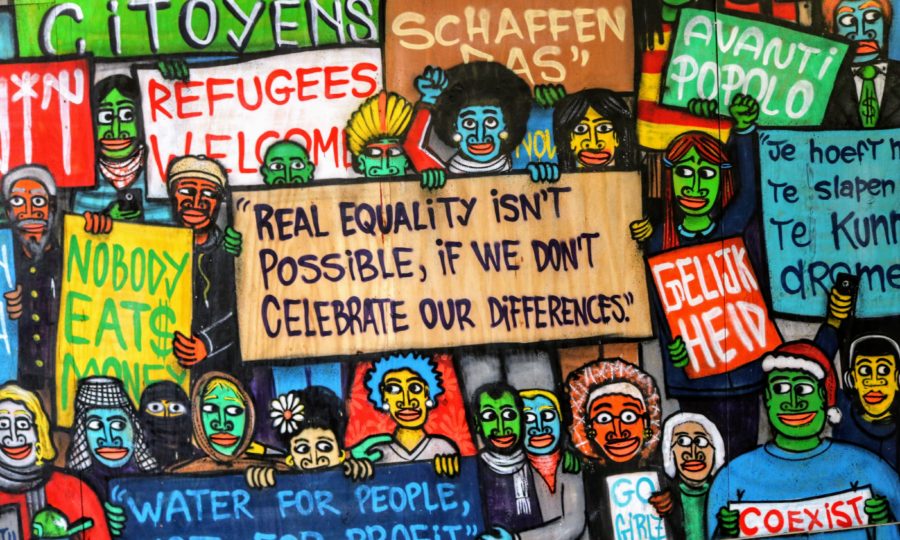
The most recent issue of Refuge: Canada’s Journal on Refugees is devoted to private sponsorship. Reading it encouraged me to return to themes I raised in a previous post about Canada’s Private Sponsorship of Refugees Program. And good news–Refuge is open access, so anyone can read these articles!
I find private sponsorship for refugee resettlement to be an opportunity to think through Hannah Arendt’s claims about the blurring of private and public concerns. For Arendt, the private, the realm of the household, is the realm of necessity where the needs of life are sustained. A person must be liberated from the ongoing work of physical survival to be free, but freedom is much more than liberty. It is relational. The public realm is the realm of freedom, where individuals have space to speak and to act with their peers on matters of shared concern. Side note: For more background, read this brief essay by Richard A. Barrett on Arendt’s distinctions between freedom and liberty.
Variations on private/community sponsorship
As I have discussed previously, to call private sponsorship “private” seems a bit of a misnomer, because sponsorship requires collective action by groups of individuals or by community organizations. In their comparison of international resettlement programs, Jennifer Bond and Ania Kwadrans use “community sponsorship” to describe initiatives where individuals, rather than governments or professional organizations, lead resettlement efforts. This language I find immensely helpful in capturing why private sponsorship resonates with people.
Community: Citizen engagement
Canada was the first nation to implement a community sponsorship program. Bond and Kwadrans say that “the core of all of Canada’s community sponsorship programs remains robust citizen responsibility and empowerment” (p. 89). Notions of solidarity seem implicit here. Sometimes “solidarity” is explicitly mentioned; for example, Argentina had a Solidarity Resettlement Program for resettling Colombian refugees from 2005 until 2013.
Ultimately, Argentina’s Solidarity Resettlement Program proved to be unsustainable because it relied too much on international funding. Governments don’t disappear from the picture with community sponsorship. They are always in the background, to greater or lesser degrees, acting as gatekeepers or administrators.
Private: Government bureaucracy
Asher Hirsch, Khanh Hoang, and Anthea Vogl argue in their analysis of Australia’s Community Sponsor Program that government bureaucracy can disempower citizen engagement. They claim that Australia’s program “in its current form represents a market-driven outsourcing and privatization of the existing refugee program” (p. 100).
This sense of “privatization” illustrates some concerns that Patricia Owens reviews in a 2012 article on citizenship in the age of the social. In the Human Condition, Arendt describes “the rise of the social,” in which private concerns, such as efficiency, consumption, hierarchy, sameness, encroach upon and replace political concerns, such as freedom and equality. Owens argues that many scholars miss the importance of Arendt’s critique of the social for understanding citizenship. It’s not simply a matter of distinguishing economics from politics. Rather, the social is about modeling politics after the structure of the household.
Private: Biopolitics
In other words, biopolitics is the issue. The state becomes a giant household. As the regulation of life becomes central to government bureaucracy, individual citizens–and the nation–become “society as a whole.” Bureaucracy is to society what the patriarch was in the household.
As Owens emphasizes, Arendt’s critique of the social is a historical argument, not a normative one. I take this to mean that we should use Arendt’s critique as a way of understanding current regimes, but not that these regimes should be dismissed out right because they are emblematic of the social. We should be skeptical of ways in which bureaucracy and social concerns dominate policy and public discourse. For example, many of the articles in the current issue of Refuge question the emphasis in policy on economic self-sufficiency over other conceptions of inclusion, integration, or independence.
Solidarity: A way forward?
Arendt’s concept of solidarity offers a productive way to reclaim citizen engagement and resist the most damaging impacts of biopolitical discourse.
In On Revolution, Arendt defines solidarity by way of contrast with pity (pp. 84-85). Both pity (a sentiment) and solidarity (a political principle) can be provoked in response to suffering. But, principles get enacted in public, whereas sentiments are privately felt. Because they are private, sentiments become dangerous when used as guiding forces for action. Sentiments are boundless and can overwhelm principles, which help provide stability to the political realm where freedom can occur.
We might say that our leaders need more compassion when it comes to refugee issues. Absolutely. But solidarity, rather than pity, is an appropriate principle which can be enacted in public. This principle can serve as a normative ground for community sponsorship.
Resisting biopolitics
Solidarity resists the biopolitical move, that administrative concerns should dominate our understanding of politics. It orients us spatially to preserving the public realm. In protecting the public realm from being overwhelmed, solidarity affirms the importance of the public as the space for appearance. Without this space, no one is able to experience freedom.
Making space for uniqueness
The preservation of the public realm entails that members of the political community, including refugees, can appear in our uniqueness. None of us are reduced to our group memberships (being a refugee, being a Syrian refugee, being a sponsor). Solidarity helps us center ways in which we are unique, and this uniqueness further enriches our political discourse and political space.
This post is somewhat of a beginning. There’s more to say about solidarity, and how a principle of solidarity can respond to problems with existing community sponsorship programs discussed in the current volume of Refuge. Stay tuned!
In the next “At home with Arendt” installment
Janet Jones will pick up on themes about the public/private distinction and contrast the debate around safe injection sites in Cambridge with the implementation of such sites in Kitchener.